
The Second Chance Convenience Store
by Kim Ho-Yeon
translated by Janet Hong
The first time there was a violent confrontation between teens and the septagenarian convenience store owner–“The girl with blond hair sidled up to the counter and spat on the floor. “Hey, granny, you a cat or something? How many lives you think you got?”–I was pretty sure this was going to be an outlier for the East Asian novel where interlinked stories center around a specific location, aka my favorite genre. In these bookshops Morisaki or Hyunam-dong, what-you’re-looking-for libraries, and seaside konbinis, or sometimes simply small apartment communities, there’s no threats of physical violence. The Second Chance Convenience Store bucks this trend by peppering in action scenes with enough regularity that fists—or snacks—might start flying at any time.
The boy reached back into his jacket and, in one swift motion, hurled the gimbap at her face. Thud. It hit her square between the eyebrows. Dazed and momentarily blinded, she let go of his arm.
He tried to bolt out of the store, leaving Seonsuk behind with her face tingling. But someone blocked the glass door from outside. It was Dokgo.
“Hey, Zzamong,” Dokgo said, smiling at the boy as he stepped inside.
It is very odd, to me.
Dokgo, the “main” character, is a bit of an outlier: an unhoused man with self-inflicted amnesia who is positioned as beyond the standard ills of society and reacts as an idealized outsider might. He responds to physical threats in kind, and when his fists cannot do the talking his halting charisma smooths out a situation. or his guru-like wisdom or intellectual flexing solves the social puzzle as presented. He’s functionally a max-stat RPG protagonist, and you’re just sort of watching him decide via whim which way to solve each of the various subquests that pop up.
I am still a sucker for this structure, though, so even if the vibe was off, it’s still fine. Dokgo unravels the mystery of his amnesia in the final two chapters and, as with all the other characters in Second Chance, he gets an, ahem, second chance to live his life. If I remember anything from this book, it’ll be the unexpected violence. Or the time banchan was translated out “side dishes” (smacks of the 80s when ramen was rebranded as “oodles of noodles”). Or maybe the time Dokgo had to leave the store unstaffed while he dealt with diarrhea, which had no baring on the plot and exposed no character growth beyond perhaps his naïvety for not locking the door. All-in-all, this book is maybe a miss. Unless, like me, you love the genre and so are content even when it is slightly off-putting.
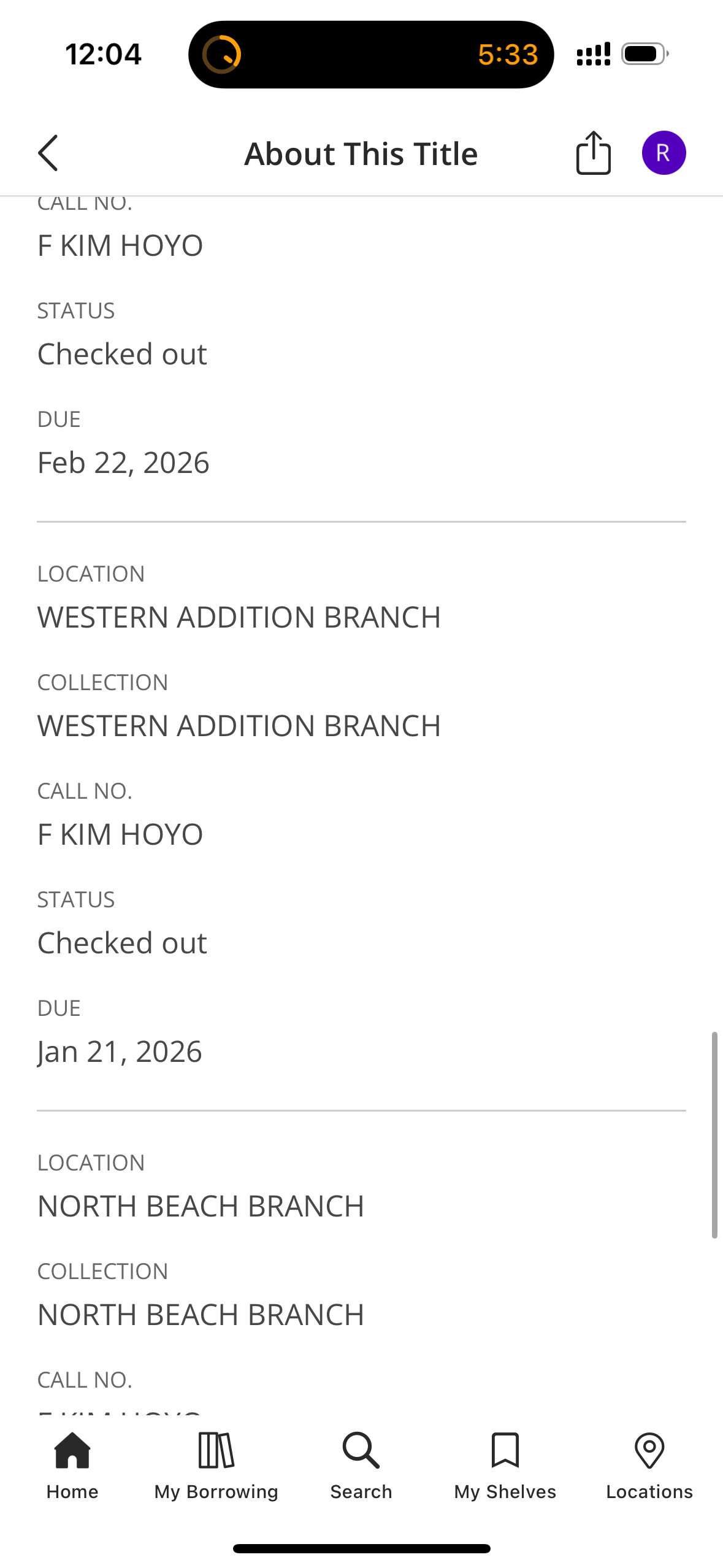
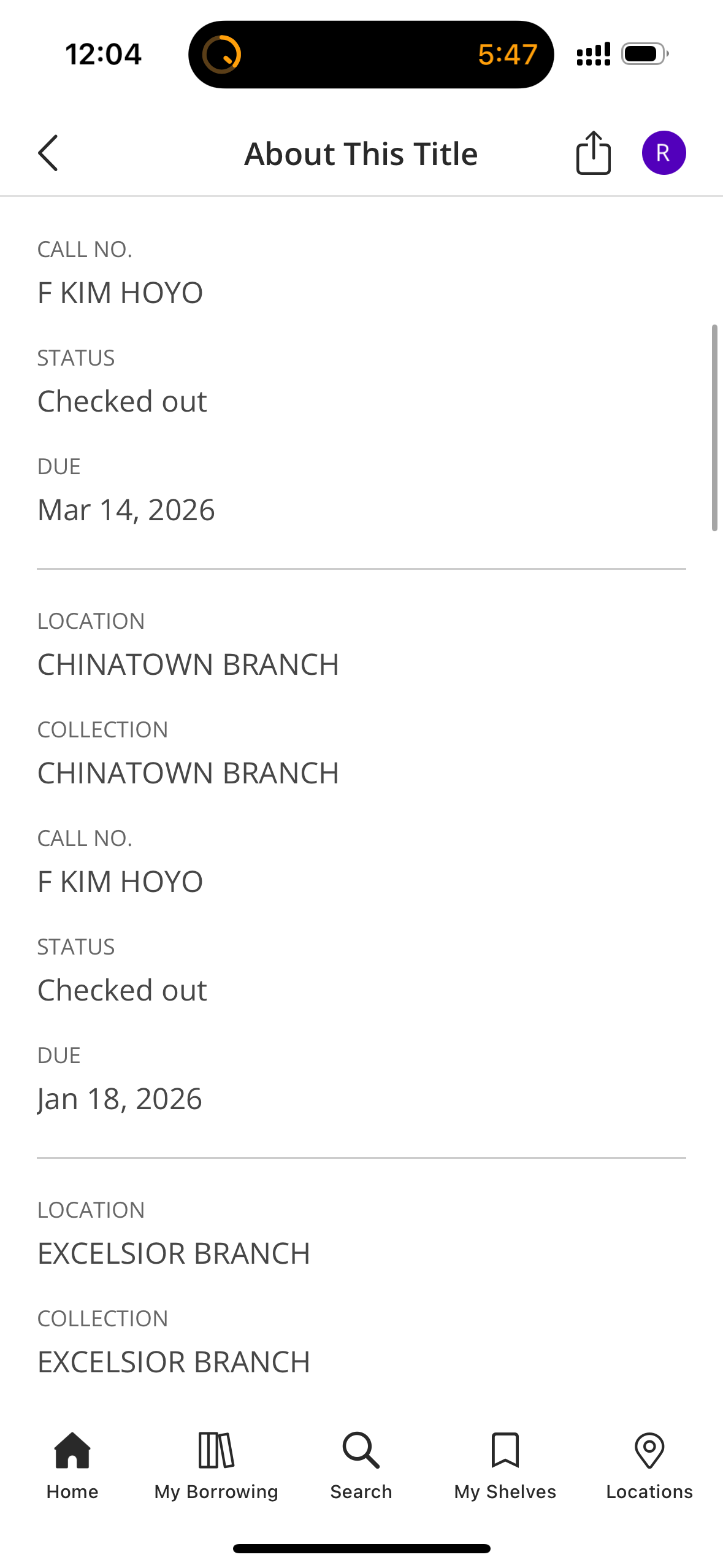
As a side note, the SF public library lets you look at other people’s request holds and the borrowed status of books, so if my book is about to be due back and I’m not done with it yet, I’ll check and see if enough other people have “due back” dates that are before mine; the dream is that enough copies will be returned to cover the requested holds and so my copy will remain free to be renewed. It happens surprisingly often.
Three people were waiting for Second Chance when mine was called to be returned. My copy was due back Feb 2, and of the ten other copies that SFPL has, two were already due in mid January, one was labelled “missing.” and one was still awaiting a requester on their “hold” shelf (to be fair, I do not know if the system removes the “requested” tag once a book is on the hold shelf. It is possible this book awaiting pick-up was one of the three requests).
I ended up returning my copy before I finished my writing and editing—you’re welcome to my fellow library-goer. No idea why this book has engendered such delinquency in its library patronage, but perhaps we’re all ourselves just looking for a second chance to be better.