
Sisters in Yellow
book by Mieko Kawakami
translated by Laurel Taylor and Hitomi Yoshio
I requested Sisters in Yellow from the library but wasn’t going to actually read it until it popped up in some social algorithm as the hero prop in a mid-sized city’s library system’s promotional video. “Hmm,” I said. “Seems au courant. Might as well.”
I’m glad tiktok knows I like seeing sketches from the Nashville Public library System (probably?), but oh boy did I not know that “librarytok” was a whole thing until I tried to intentionally find that video for this review. Searching? On the internet? What is this, 2002? When it comes to “content,” we’re all treated as kindergarteners, now: You get what you get, and you don’t get upset. So while the video remains undiscovered, I will pretend that the provenance of its discovery matters less the providence of its discovery.
As tends to happen when dealing with any source of kismet while choosing what to read, I did not have a strong understanding of what was about to unfold. Meaning I chose this book at random and didn’t know anything about its plot. Unfair though it may be, it is impossible for me to see “yellow” anywhere in a title without being a little creeped out: both The King in Yellow and The Yellow Wallpaper lurch to mind. Sisters carries this legacy, at least when Hana is feverishly scraping off the messy yellow paint:
Kimiko had her back to me and was completely still, asleep, but even so I knew she was staring at me. It’s all your fault. You did this. Kotomi’s dead because of you. I didn’t know whose it was, this voice I could hear so clearly, this voice that had grabbed hold of me and wouldn’t let go, so I picked up the box cutter next to my pillow and went downstairs, and far, near; the splotches of yellow grew and began to chant. It was you, it was all you—
Unsettling.
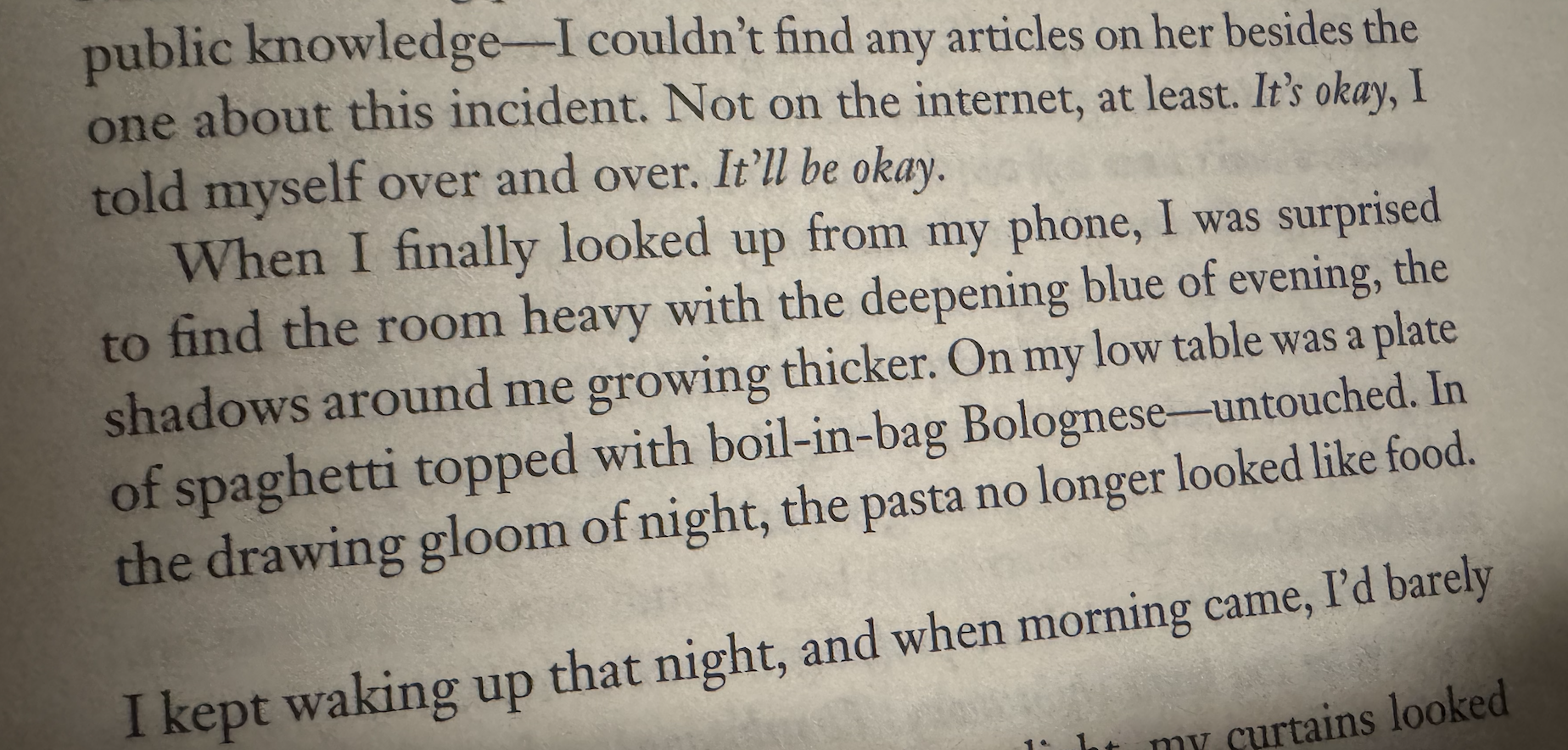
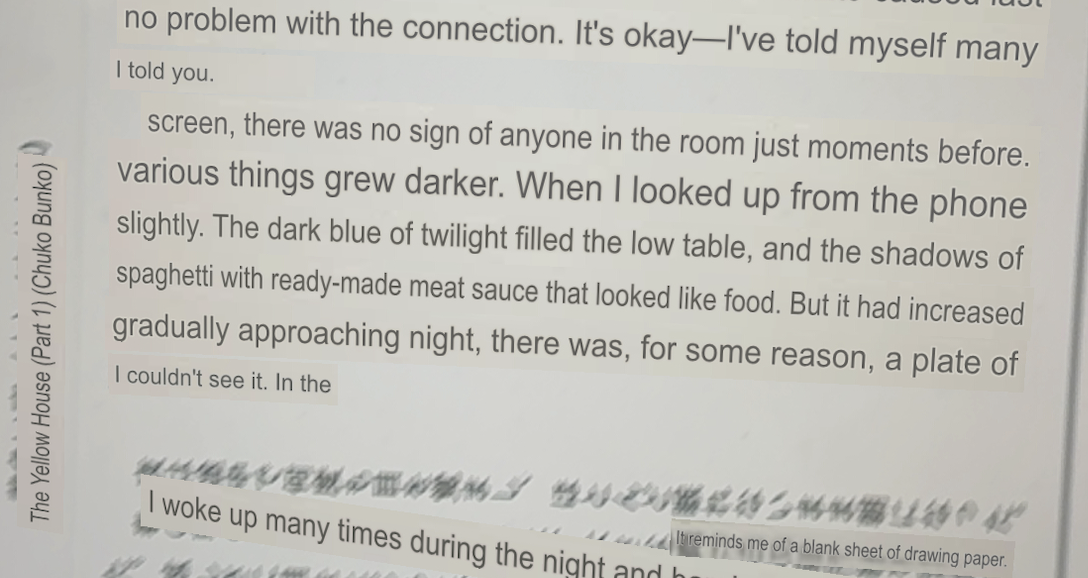
The other thing that struck me right away was that, like all works of translation I pick up, I’m instantly suspect of how much is going to be shifted to cater to my American-default chauvinism, the cross-cultural nullity of not knowing what stuff means outside of my little societal bubble. In the first three pages, Hana is eating “a plate of spaghetti topped with boil-in-bag Bolognese,” and my onigiri-to-donuts alarm went wild.
This was misplaced. Hana was definitely just eating spaghetti bolognese, which probably has its own cultural significance that I can’t comprehend.
For the remaining pages she’s going out for yakiniku, eating pork buns under the kotatsu, ordering omurice, worrying about frozen eel kabayaki, and jumping around neighborhoods, like Higashimurayama, that I have absolutely zero context for. Honestly, I know so little about how Tokyo is broken out that Higashimurayama could be a whole different city, more like a Hempstead out on Long Island than an Astoria in Queens.
Looking back across the whole work, poverty tourism looms large. Sisters is a bit refreshing for me, even in that overworked and quite sinister milieu, because the list of contemporary Japanese fiction books I’ve read lately deal a lot more with fulfillment and cozy comforts than scrambling for cash and bending the laws to continue to survive. Hana’s slow decent into petty crime is fully reasonable and structurally coherent, but it still sucks to watch her clearly lose herself over and over. If there is a main pulse that Sisters in Yellow lives by, it’s that if you lack even the basic protections of a social system–bank account, ID card–any moment might leave you to the whims of fate:
“I don’t know. I don’t know what happiness feels like.”
“There are happy people out there, for sure. But they’re not happy because they have money or a job. They’re happy because they don’t think,” Viv said. “You can use your brain, Hana, right? So that’s okay. That’s enough. Just use your head and earn money. If you live a normal life, and don’t get into that gambling shit, then money is the easiest form of power. That’s not a bad thing. When you rack your brains and work your body and finally get your hard-earned cash, you understand how stupid and disgusting those jerks are, the ones born with money who never had to suffer for it. So you’re better off.”
Hana becomes obsessive (from the yellow! It is always a danger!) and mean to her found family, pursuing money for its own sake without any clear goal of how to apply it toward improving her actual life. It’s stressful–money is the path to happiness, or at least safety, until it stops being the journey and becomes the destination–and having a character with nothing else motivating her actions emphasizes how empty the pursuit of wealth ends up being. Kimiko, her erstwhile caretaker, who has no plan at any point in her life, survives at the same level as Hana. So while one is thrashing her way through the water, the other is floating, nearly immobile. They both exist in nearly identical circumstances.
Whenever I remembered the two million I gave her that day at the restaurant, it made me so depressed I felt sick to my stomach, and even now tears of frustration welled up in my eyes. I still couldn’t quite believe I’d handed over so much money. But even worse than that was the piercing sadness, frustration, and sorrow that overwhelmed me every time I thought of my mother.
Hana just keeps grinding out money and having it stolen, or handing it over to cover the debts of others: multilevel marketing debt; a (possible) insurance-fire scam that destroys their livelihoods; a ticket-purchase scam that preys on social insecurities; general guilt-induced financial abandonment. Hana. Hana! Hana, please take the money you gave yourself up for and go somewhere peaceful. Please. Everyone else runs off with your money. Just take it, and go.
The vivid and complete picture of Hana as a late-teen-early-adult will live in my mind far beyond the shape of the plot. She’s a full person making believable choices in tough situations. We really only get to see her as she recounts the most difficult time in her life: everything afterward is glossed, her present day existence mostly ephemeral. Upon deep introspection, anyone’s life choices will seem both absurd and impossible to have gone any other way. The path that brings every person through their past and into our shared present is dotted with unlikely events, but since they all happened, well, 100% hit rate, right? I’m not going to not see this book on at Green Apple and then have it appear again on social media, and if I hadn’t, I wouldn’t have read it, and then I wouldn’t have written this, and you wouldn’t be here reading it. So if you’re here, now, take from these words whatever portent you’re looking for. Start in on Sisters in Yellow. Visit Higashimurayama. Order omurice. Read the rest of my website. Do the thing for the thing.