
Break Room
book by Miye Lee
translated by Sandy Joosun Lee
The documentary film is the last bastion of naïveté in modern media. Neatly functioning as a way to not hire professional actors or require WGA labor, its hidden deceit is in making an audience forget that the bulk of film-making is not done when the cameras are rolling but during the editing process. Footage, however it is captured, is structured into a cohesive and intentional narrative during post production, whether from reality competition, hidden camera, staged performance, or a green-screen soundstage.
filmmakers love the edit
The narrator of Break Room acknowledges the untruth of reality tv after his stint on the reality show Break Room, which is a reworking of a failed documentary series of the same name. Ice Cube, our competitor/narrator, is mostly edited out of the major reality show narrative:
The inner turmoil I’d experienced while filming didn’t make it on to the screen at all. There were brief shots of my face that captured fragments of my emotions, but my distress had clearly been overlooked by the editor, leaving me relegated to the background – little more than part of the set-dressing.
I was grateful that my internal struggles weren’t visible on screen, yet I couldn’t help but wonder whether, in all the reality shows I’d watched in the past, had I ever truly seen the truth of what was happening? Or was I only ever seeing what someone had wanted me to see?
What Break Room the book uncovers, for me, is not the pedestrian story of competition amongst office-worker “villains” who are selfish or annoying or thoughtless, but the introspective journey of Ice Cube as he realizes his self-perception is fabricated in much the same way as a documentary is edited together.
His code name in the book is Ice Cube because his co-workers found it villainous that he put cola and coffee in the break room ice cube tray.
‘Ice Cube? This way,’ called out a young male staff member, gesturing for me to follow.
‘Oh, okay,’ I replied, surprised by how I’d so readily accepted being called by my alias instead of my real name.
The rest of the cast is on the show for being selfish or off-putting–filling the fridge with large cake boxes, hoarding all the top-tier snacks–so I assumed that finding ice cube trays filled with non-standard frozen liquids stymied people who wanted traditional water-ice. Or perhaps he left a sticky cola mess each morning or something.
We find, near the end of this impressively short book, that he is a snoop, and it’s creepy.
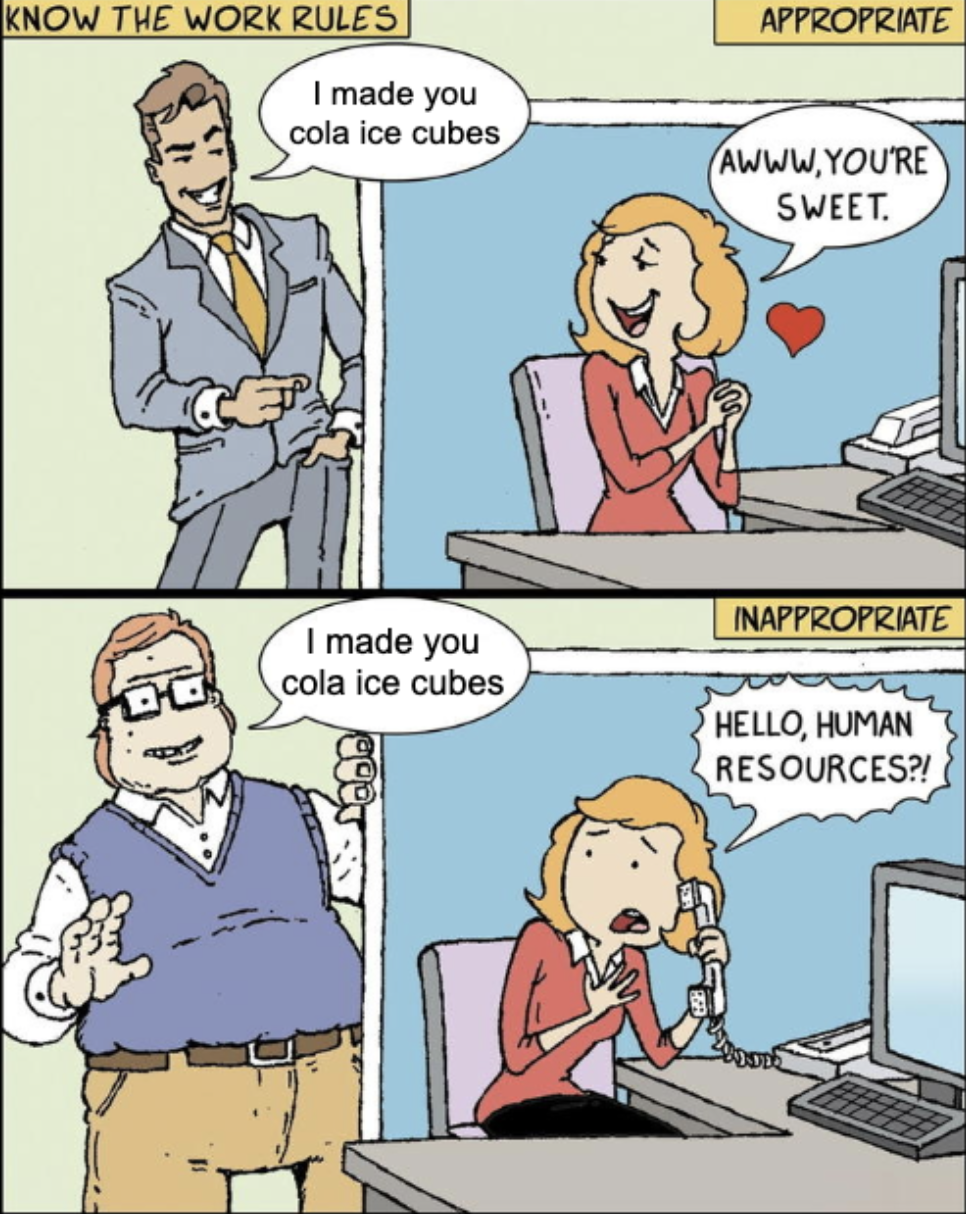
I don’t like the visual shorthand because weirdos can look like anyone, but the meme holds. The acceptability of mostly innocuous actions depends on how you feel about the person doing them.
Ice Cube makes bespoke ice cubes to keep his co-worker’s drinks from being watered down by the slow melt of traditional ice. It was unasked for: he picked through the trash to learn people’s brand preferences. Further emphasizing his creepitude: he memorizes people’s lunch orders, watches them intently and files their habits and quirks away to benignly (in his mind) make their days better.
Making cola ice is easy, but the dolce latte ice cubes? Those took effort. I’d half-freeze the cubes, add sweetened milk midway, and then freeze them again to get the taste just right. It was time-consuming, but I didn’t expect anything in return. To me, it was just a thoughtful gesture – an act of goodwill.
The translator’s note talks about giving the narrator a proper tone: “His tone hovers between socially awkward, obsessively detailed, and at times teetering on incel-adjacent. The goal was to preserve that uneasy edge while still making him compelling – and sometimes even unexpectedly sympathetic.” And it worked, for me anyway, because he is weird and off-putting but still got the beneficial power of being the voice of the story.
I didn’t really like the book until we got to the revelations:
‘Will it be that person we discussed before?’
‘No,’ Cake replied flatly. ‘He’s not it. He’s genuinely…off-putting.’
‘True. That’s not something you can just act out. He probably doesn’t even realize h’s weird – and never will.’
I thought their conversation about Monologue’s quirks had gone a bit too far.
‘Exactly. Ice Cube doesn’t have a clue; he’s probably always like that.’
My thoughts came to a screeching halt.
Since the whole thing is quite short, getting any sort of juice out of such an simple squeeze makes it a fine way to spend your finite time on earth.
Yikes. Speaking off creepy and off-putting, what an odd way to recommend a story: “Use up some of your finite time on this earth pretended these words represent real people. Subtext: you will die someday.” Someone should really fix that line in the post-production edit.