
Like This, But Funnier
by Hallie Cantor
I don’t have many hard and fast rules about writing, but one I try to hold in my hands like I would hold a tiny, orblike baby bird I saw flitting about on a sidewalk that, in reality, I shouldn’t hold in my hands because if a tiny orblike baby bird is on the ground and is orblike and adorable, it means it has feathers–featherless birds are not adorable–and thus is learning to fly in an appropriate manner and should not be fiddled with is to not to make the reader experience tedium, even when you’re trying to convey tedium.
It’s boring! You don’t need to make reading boring to convey that something inside a story is boring. I will extend this rule, after reading Like This, But Funnier, to not immersing a reader in non-stop grinding pessimism, even if the protagonist is anxious, defensive, and self-sabotaging. It is wearying.
Caroline, the protagonist, can absolutely still be those things! A protagonist can be flawed, can even be bad. But I don’t want to inhabit it. Write about being sucky without the textual experience actually being sucky. Ahhhhhh! I mean, maybe I’m the weird one, because I don’t like antihero shows; I watched only a small amount of Breaking Bad because I found Walter deeply unpleasant. Sure, he’s supposed to be unpleasant. And the audience is not supposed to root for him, but we do, because familiarity and perspective trump decency (unless you are The Stalker, where damn my skin is still crawling from Doughty). Like This takes its cues from TV shows: “No one expected good girls to react to their problems with violence, which made it all the more exciting to imagine them snapping if they were pushed far enough. Really, all she had to do was pitch Breaking Bad but about a pretty girl. Easy enough.” I recall being a younger person and absolutely losing my mind when a song would reference another real-life song, so reading a book about TV production that mentions real TV shows is definitely doing something for someone. I am still not immune: Kevin Can Go F**k Himself got a nod, which made me inappropriately pleased: “Hey, I liked that show. I must be smart and cool.” Sneaky book.
But back to the novel: we aren’t watching a charismatic actor decode and express a palatable neuroticism to us, in the way a beautiful person like Tina Fey is pretend unattractive within the context of her thespian and filmic pursuits. Caroline is maybe-sort-of being used as a mirror to the hypocrisy of a female lead needing to appeal to the audience:
Because that was what all the notes boiled down to, from the earliest stages of the project. Everyone was so worried about how audiences would respond to Jane, She was too passive, or too selfish, or too angry, or too confused about what she wanted. Executives knew they weren’t supposed to use the word “likable” anymore, but that was the essence of what they were saying, Audiences weren’t going to like Jane. And if they didn’t, they wouldn’t watch.
The author clearly knows what is up and is definitely saying something about who gets to be a female lead, because Caroline is deeply unpleasant but also insightful and interesting at times.
“Maybe she was was overcomplicating everything with her worries about what was good or bad to want and why, her insistence on measuring herself against the labels of good person or real artist or likable protagonist. Maybe she didn’t have to be any of those things.”
But spending two-hundred-plus pages with someone who misinterprets nearly everything as a personal failing—“When she cooked, she gripped a recipe like a lifeline, too timid to improvise and resentful when here meticulous instruction-following yielded lackluster results”—or a cosmic insult— “The wooden fish stared at her, its painted black eyes empty. What a grotesque fuckup you are, it observed.” is less a study in character work and more akin to masochism:
When Nadia called to check in on how the outline was going, Caroline didn’t even bother searching for a way to say “they’re making me show the protagonist get sexually assaulted twice and the show’s supposed to be a comedy” that didn’t sound whiny.
Caroline’s constant bad vibes are far closer to having risque content like sexual assault jingled like keys to engender feelings of sympathy from an audience. Stuffing Caroline full of “unlikeable” traits seem designed to prove that complex, “unappealing” woman can carry a story, but that metanarrative element forces the story to constantly be assailed by someone unlikeable and unpleasant. It is like the book takes a page from health food clichés to spray a “tastes bad must mean it’s healthy for me” misalignment across the whole book. (A contemporary book set in L.A. that avoids the cheap joke-reference to Erewhon?! I shall follow suit. Whoops.)
To quote a different deeply unrelatable but much more watchable female lead, “I don’t really need to see that!”
“I don’t really need to see that.”
“I don’t really need to see that.”
“I don’t really need to see that!”
Nailed it.
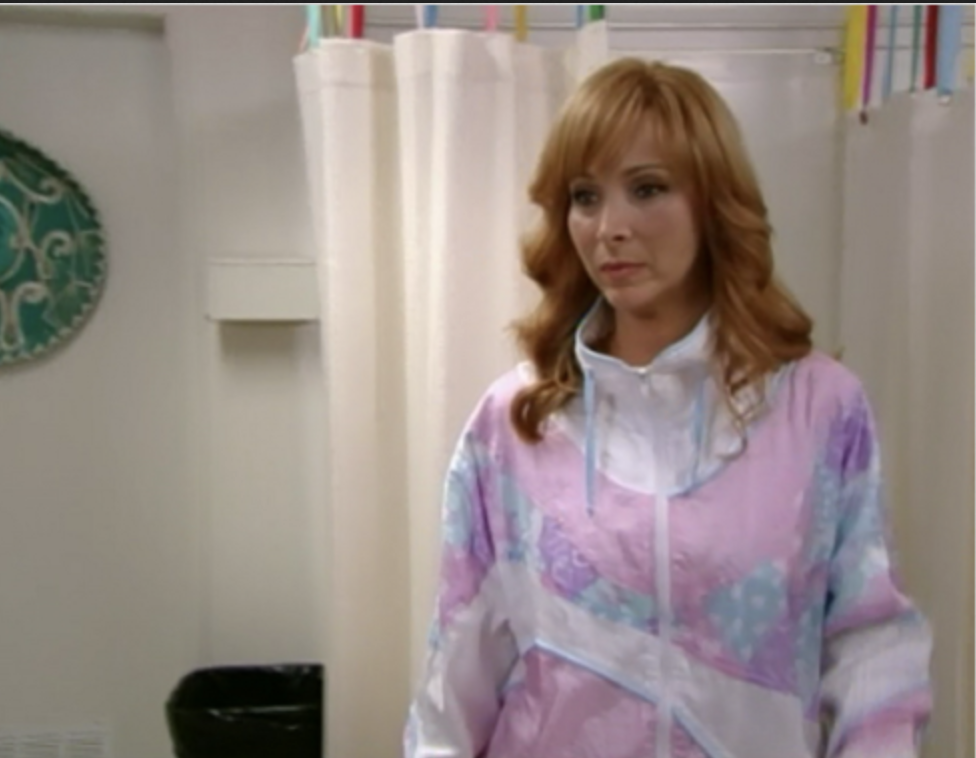
now in SD (can we keep calling it “standard definition” when it is no longer the standard?)
All right, so, we’ve got “strongly disliking the general shape of our main protagonist” out of the way. But what about the things she does? (Wow, covering characters and now moving onto the plot? What a comprehensive review!) She’s a screenwriter, she’s got some business stuff going on, there’s a snowballing misunderstanding about the core of her pitch that she continuously covers with foolish lies and self-immolating choices. Wait, this sounds wacky. Have we’ve already forgotten it’s not wacky because Caroline is unfun to inhabit? Reminder:
“Caroline felt a sinking disgust at how eagerly her own vague and obvious bullshit was being received. It was embarrassing for all of them. It was like she’d just announced she wanted to make a show about this totally new phenomenon she’d just discovered, that actually, if you think about it, the sky is blue.”
That’s annoying, right, the self put-downs? Have a little bit of self-confidence, girl! There’s a lot of that. But while “not liking your job” is a fine sitcom premise (and is, in fact, Caroline’s script’s original premise), not liking yourself is rarely funny (to me?). Perhaps Like This is also attempting to bifurcate personal and professional life; Caroline is funny in a writer’s room but kind of a dud just out and around, like your job need not be your whole persona? I don’t know.
I feel like I’m slamming the book a lot, but there was still something in it that kept me going. It’s just that all the good bits that shine through come filtered through Caroline’s unpleasantness. She’s still insightful, often knowing what is going on in her head even when she doesn’t like it:
She wanted gold stars and pats on the head and someone to say wow, good job, what a bright shining beautiful star you are, what gorgeous things you are doing, how lovely you are, my dear darling, so good, you’re so good.
But she wanted it for what her brain did, not her body. She wanted praise for creating something no one else could, making art that had the power to elicit new insight and emotion in a stranger. Not for passively incubating a baby that would act exactly like every other baby in the world.
There’s the other big, parallel, quite-well-done storyline; Caroline does not want to have kids. And her husband, who recently changed his mind to potentially wanting to maybe have kids, has created what a self-doubting neurotic hates more than anything in the world: a position where advocating for themselves makes them feel like they’re letting someone else down. Speaking as a self-doubting neurotic, I would prefer you read my mind and never ask me to even think about doing something I don’t want to do, please, because my saying “No” to you creates a whirlpool of guilt for me! At least that’s how I see it, and how Caroline, who ends up freezing her eggs even though she is still sure she doesn’t want kids, seems to me to see it as well. To be clear, I don’t think the book could have painted Harry, her husband, as more of a saint even if his “wants” (or whatever industry jargon is used for the motivation that drives a TV show lead) weren’t at cross purposes with Caroline’s. He never pressures her, just advocates for things he wants that, if she were honest, he would probably let drop. But while I liked this whole “Don’t fall in the mom hole” b-plot, I found it deeply jarring that anyone’s couple friends with children would advocate for childless couples they know to have kids, too. As a SAHD with literally nothing else going on who is thrilled to know the pros and cons of every playground in the city and could not be happier to be reviewing kindergarten-level voluntary math workbooks, I have never once advocated for anyone–especially someone who is unsure about it–to have children.
So. The best stuff in the book: Caroline’s occasional honesty with herself; her ability to swing from self-aggrandizement to self-flagellation in a believable (if unfun) fashion; the skewering of an industry in a way legible even to the laity. All of that still didn’t lean very hard on being funny. There were a handful of jokes that I liked a lot: Caroline taking consecutive phonecalls in a hallway:
“…and a businessman walked down the hall whom she was pretty sure she’d seen on her last hallway phone call. She gave him a nod of acknowledgement form the floor–yes, hello, I am the cursed troll who makes my home in this hallway.”;
the email exchange where she is given conflicting and often incomprehensible notes from various executives:
“Are the other teachers similar to Jane? Do they like Mrs. Gruner? Do they like the principal? Do they like the parents? Do they like each other? What do they wear? What kinds of cars do they drive? Etc.
BTW–let’s trim this doc way down, like to 1 page if possible?? We want to keep it snappy for readability!! Thx”;
the contrast between dilapidated Americana and youtube influencers:
[Harry]’d offered to do [the fertility injections] for her, which was nice but felt a bit too much like a tableau from like, a Tennessee Williams play about a poor couple who had scrimped and saved their pennies so the Lord’s medicine might finally answer their prayers for a baby. Plus in all the YouTube videos she had watched, the women did the injections themselves.
These got real laughs out of me, delighted and bright. But the promise of Like This’s premise landed a bit awkwardly, like the using “promise” and “premise” in quick succession. It’s not clear to me what the book wanted to do, so I can’t really say for sure whether it did it. Caroline is too pessimistic to enjoy experiencing, but not absurdly bizarre like the narrator from, say, My Year of Rest & Relaxation. What are we supposed to pull from watching her quasi-believable, absurd but ultimately kind of tame responses to the Three’s Company plotline of misunderstandings that all derive from her feelings of professional and socio-structural inadequacy?
The book is not zany enough to drag the professional sphere into the personal, not caustic enough to strip away the likability issue surrounding women in lead roles, not bleak enough to pierce the frivolity of media production. It’s kind of a safe plot with a unlikable lead that rhetorically asks, “Hey, why do you want success? What does success even mean, anyway?”
And then sometimes Caroline plugs a toilet with a massive dump.