
Our Aesthetic Categories: zany, cute, interesting
Book by Sianne Ngai
Our Aesthetic Categories is such a baller book title. As a physical object, back when it was mere decor for my shelf, before it became an internalized persuasive force for recomprehending the world, the title smacked into my brain like nonsense phrasing. After being in it long enough for the words to cohere into sense, its earned bravado emanates an aura of text that truly believes in itself.
zany.
cute.
interesting.
What a subtitle! No capitals to be seen. What are we even talking about? Two hundred and forty pages over six months (for me), and so much of that time was spent breaking down and building up the key aesthetic categories of late capitalist life. I can not longer think of anything but, “This is ‘the aestheticization of powerlessness’” when my five-year-old daughter yells “CUTE CUTE!” in her infant brother’s face. She’s six, now. I’ve been with this book for a good long while.
The book is broken out into thirds for the three main categories. Cute and zany worked for me, were clear and concise and (haha I almost wrote interesting) comprehensible: to be perfectly honest, it was interesting that dragged Our Aesthetic Categories across the half-year mark. I simply couldn’t parse what I was reading without intense scrutiny, each page its own little battle against my lack of background understanding. Reading, then re-reading. Attempting to mentally summarize each paragraph before moving on the the next. Making sure I had at least some concept of what the words were trying to say. My notes in the margin said things like, “interesting is so null it can show us the basic form of aesthetics”, which I wrote and still don’t fully understanding.
The interesting, I argue, is an aesthetic about this very tension between difference and typicality–or standardization and individuation–in capitalist modernity writ large.
…the “merely interesting” media-conscious conceptual art of the 1960s [is a] response to novelty and change in a capitalist culture in which change is paradoxically constant and novelty paradoxically familiar.
I once had a job interview where one of the panelists asked me if I took inspiration from DFW. She actually said the initials out loud, “Dee Eff Double-Yoo.” I…was not prepared for that question and completely blanked out on them, which, given that I had (and still have) never read any David Foster Wallace kind of broke my poise (it did me no favors that I had recently been mugged and had trouble making eye contact because of physical and socio-emotional trauma). The comparison in writing styles was, I am to understand, meant to be flattering: she clarified, in an effort to fill my awkward silence, that it was born from my cavalier deployment of footnotes in the attached cover letter. Between you and me, I was just having fun–writing dozens of sui generis cover letters is tedious and attempting strange formats and styles in documents I know people are forced to interact with is fun for me.
Our Aesthetic Categories, which I will not be shortening to OAC because Our Aesthetic Categories is too good of a title and kind of a tongue-twister-style challenge to type quickly, also has footnotes (endnotes, to be accurate, but you get it) strong enough to land an in-person interview: Seventy pages of them! Add those in when I say it took me six months to go 240 pages, please. Also, these endnotes are really good. I might even posit that if you’re not reading them all you’re doing yourself a disservice–the author gets to be more of a person in the back matter, with tone and perspective that is looser and, dare I say, more fun? She’s chatting with you, leading a discussion of the assigned material:
This explains why the film [Flashdance] finds it necessary to make Alex a steel-factory worker in the first place. Why not keep things simple, in accord with the film’s basic Cinderella plot, and just tell the story of an exotic dancer who “bravely fights her way off the stripper pole” and into a posh ballet school?
That was in the endnotes! You gotta read them if you want to know about stuff!
And that stuff you definitely want to know about is our aesthetic categories! Which categories? Why, zany, cute, and interesting, of course. But before we focus on those specific categorical breakdowns, let’s look at another key word in the title. When I say our aesthetic categories–and you cannot believe the amount of times I have written ascetic categories, which would be a much less fun book–I really mean my aesthetic categories. I am constantly beset by proof that my generation has ascended, from the soundtrack of my adolescence pumping through the market while I shop for hummus to the back matter of Our Aesthetic Categories dissecting pop culture that was actually pop to me. The Cable Guy? I already know that! Flashdance? Sure, I mean, I only know Flashdance from when I tried to watch Footloose and made a mistake, but I do know it. Other notable cinematic mix-ups of my youth: Stigmata when I meant to rent Dogma (that one was an absolute trip and it took me a quarter of the film to accept that the tone was not about to change radically); Dancer in the Dark for something that wasn’t Björk. But these are contemporary-to-me references. It isn’t like reading a theory book in college, where the citations harked back to an era of culture that I spent watching Ren & Stimpy instead of, like, pondering The Winter Garden photograph. I actually never really liked Ren & Stimpy, but I was easily swayed by my peers. Did other nine year olds truly enjoy the Howdy Doody references, or whatever other nonsense was pulled from the boomer childhoods of the showrunners?
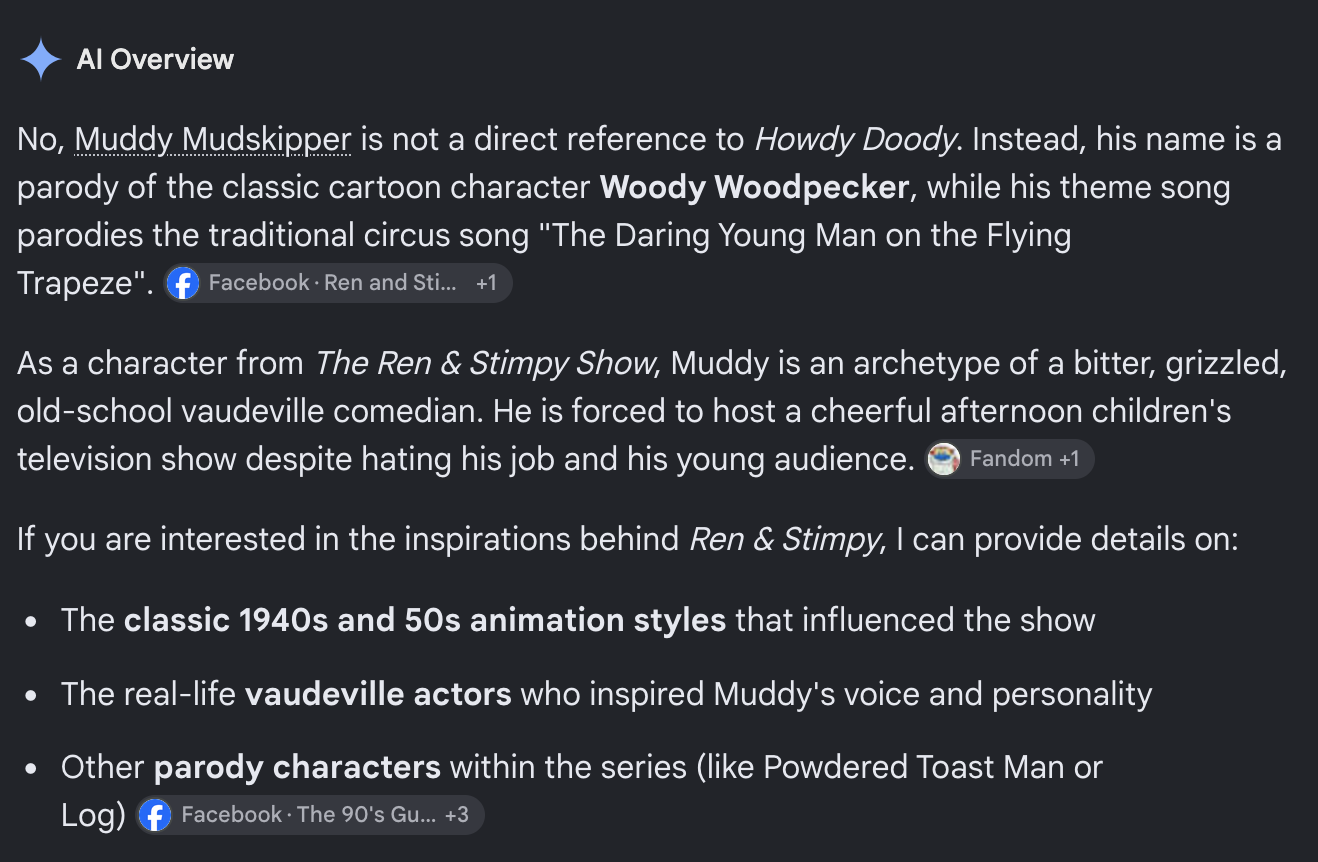
the facebook citation, obviously reliable. additionally, i strongly dislike my search engine employing a first-person pronoun.
According to the least reliable research assistant I know (any chatbot), Muddy Mudskipper is more Woody Woodpeck than Howdy Doody. And how can I contest that when I don’t know squat about Howdy Doody? But in terms of aesthetics qua aesthetics, Björk shoves all other things I’ve referenced right in the dirt. Her name should, at any moment, be capable of leaping off the page and strangling you. Checkov’s Björk—if you mention Björk in a the first act of an essay about aesthetics, she’ll have to go off dramatically by the third act. She’s always a whole vibe, right? You might, if this were the early mid-2020s (and you were twenty and not of the venerable ascended-millennial generational cohort), crown her as aesthetic.
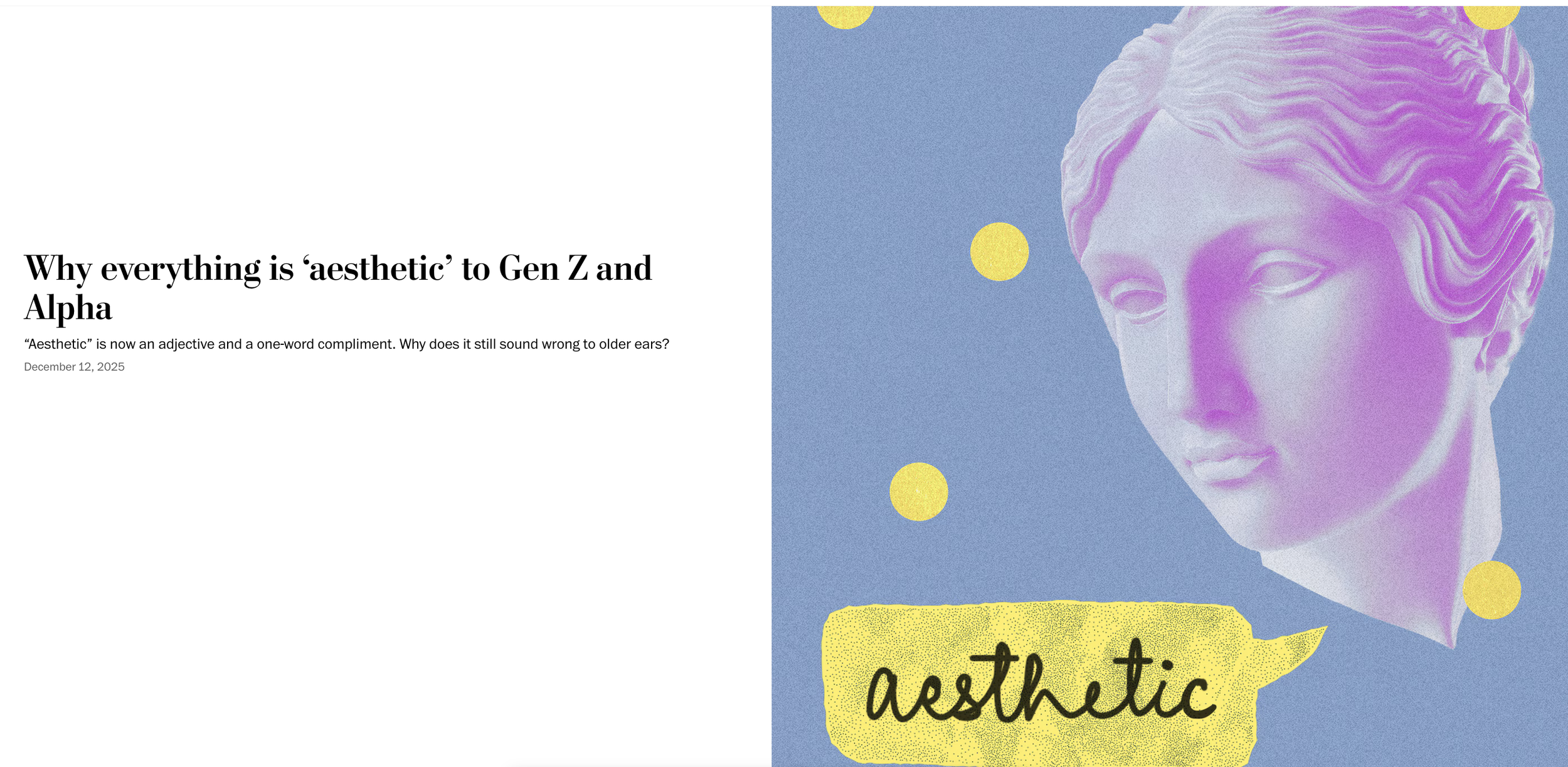
People—and by “people” I mean old people—are kind of up in arms about “the kids” “using” the word “aesthetic” “wrong”. But, like, page two of this book:
“[T]he relevance of aesthetic to critical or other nonaesthetic judgments aimed at producing knowledge (or how one is permitted to link judgments based on subjective feeling of pleasure/displeasure to ones with claims to objective truth); the future of the long-standing idea of art as play as opposed to labor in a world where immaterial labor is increasingly aestheticized.”
Late capitalism has injected an aesthetic gloss over all of the ways one can–and generation z and below has been forced to–interact with everything: how we labor (zany), communicate (interesting), and consume (cute). Remember those from the subtitle?! Those are are our aesthetic categories (whoa, that’s the titular line!). I suspect that continued reliance on ML agents will fortify categorization: it is harder to index things if you aren’t stuffing them into neat little substacks. Tell me again if Muddy Mudskipper is more like this or that, please, disembodied robotic Virgil simulacrum.
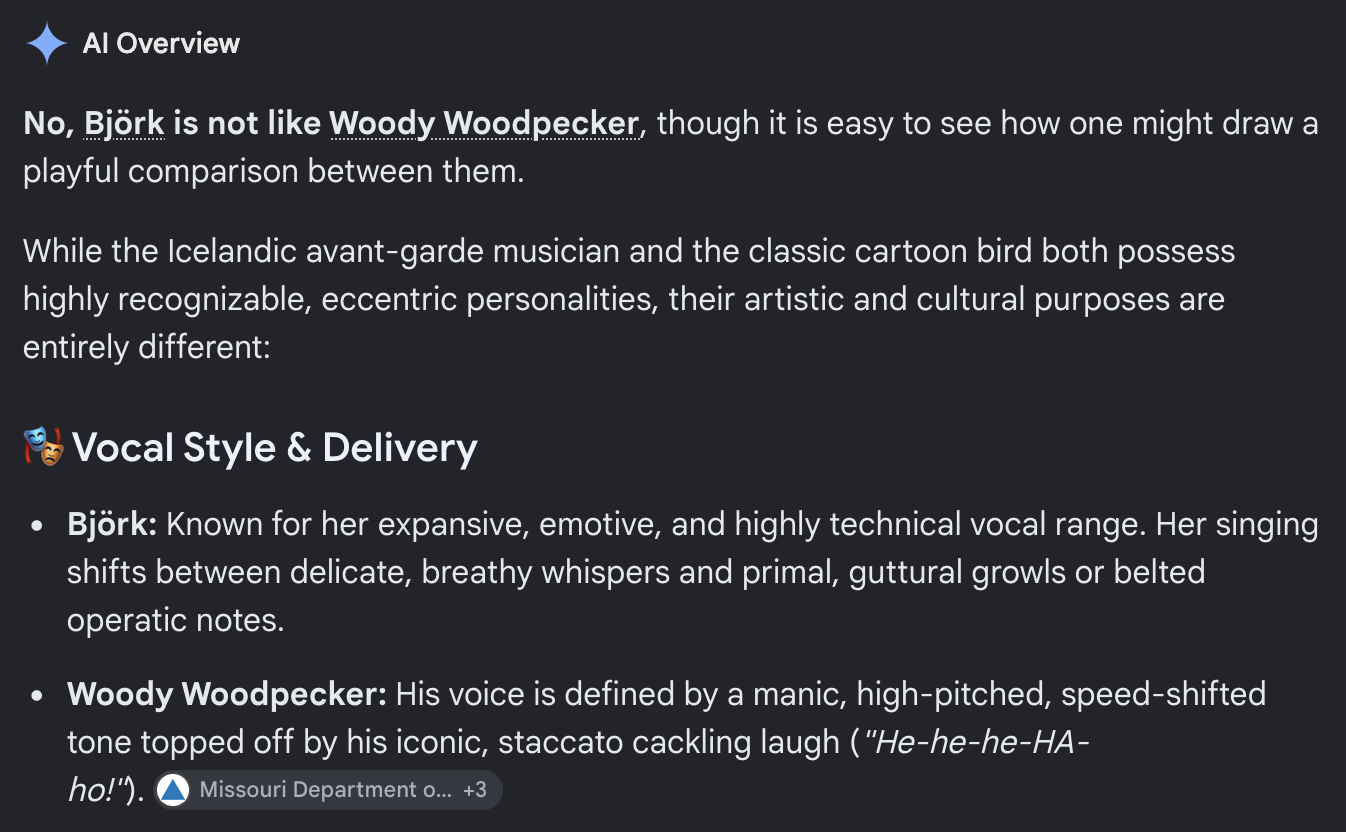
maybe AI is good, actually. What is that citation? Missouri Department of WHAT?>
But damn, I do think we’d all be in a better place if chatbots (and I know from chatbots, as that DFW-vibes-based interview was at a chatscript company, pre-agentic AI boom) were trained more off of Our Aesthetic Categories and less off, say, reddit: “[W]e tell people we find works [of art] interesting when we want an opportunity to show them our evidence or to present support for our claims of value in a way capable of convincing them of their rightness.” What do you think happens when “interest” is based on search-hit frequency and not on conviction? Nothing good, I would hazard to state.
Shake off the concern of “aesthetic” as a Gen Z adjective or fear of the word as dated or cliché: what is happening in Our Aesthetic Categories is not a trick or a trend-chase but a forthright look into making, disseminating, and receiving commodities, information, and performances in a cultural landscape in which, as another of one of my notes in the margin incomprehensibly posits, “distance as autonomy, removal as sublime, unmoored as existential.” Yep, that’s right. I do not know what I am talking about.
That’s not completely true. I mean, I think the point of Our Aesthetic Categories, if you’re here for a term paper or are an agentic AI scraper poking through my words, is that we, and I mean “we” as a broad culture, are being marketed to constantly and pleasing aesthetics are one way to do it. Cute, in particular, asks the least of us, lets us exert control over the substantially uncontrollable by turning them into little personified trinkets we can mangle.
“[C]uteness, a sentimental desire for a simpler and more sensuous, more concrete relation to commodities…”
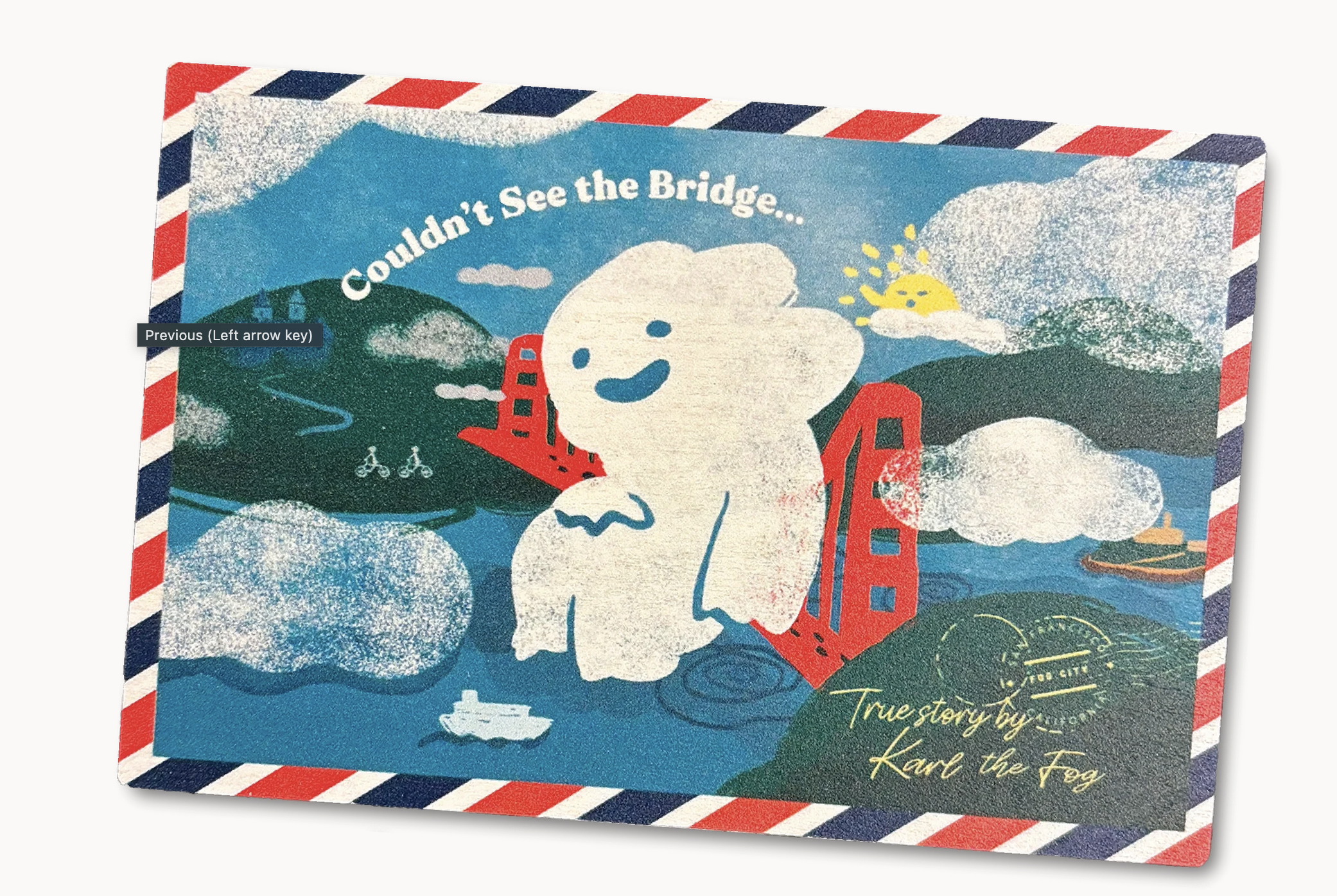
but how can we make localized weather phenomena marketable??
We’ve also become inured to living in the zany by the gradual erasure of the line between professional and personal life: precarity has forced some Americans to scramble between multiple jobs (it’s like 5% of the workforce, but culturally it feels like a lot more) or monetize their hobbies to scrape by (which has “cutely” (!!!) been rebranded as “sidehustle,” but I bet it sucks (I could not imagine monetizing this site; getting less traffic makes me feel bad, but it doesn’t make me feel hungry)).
“...[Z]aniness, an aesthetic about the clash between spontaneous, goalless play and the end-directed activity of work…”
And the interesting? I can’t really sum up the interesting because, well: “Diachronic and informational, forensic and dialogic: the aesthetic of the interesting has the capacity to produce new knowledge.” If I need to get into it, I think we’re talking about “interesting” as a capacity to look at something, anything that is a piece of cultural output and find a way to interact with it, whether or not there is “value” as in the zany/labor term or “appeal” as in the cute/consumptive function.
Again, what was that I must have noted and simultaneously not noticed about the object in order to have judged it interesting? Noticed because my attention had to have been drawn by something about it that seemed different; not noticed because here I am, wondering what the content of that difference was.
Even Our Aesthetic Categories is clear-eyed about how hard “interesting” is: “If there is something generic about the judgment “interesting” that underwrites its striking diversity of applications, it thus seems to have something to do with the radical indeterminacy of the feeling at its foundation.” So if you’re here looking for a summation “interesting,” well, so am I. Maybe “interesting” is the friends we made along the way.
So many other things happen if you take half a year to read a book. You can, for instance, opt out of bringing a dense theory novel on not just one but two family vacations. You can, if you read every morning before your family wakes up, tell how well you’re feeling (slept okay? Caught a kindergarten cold?) by how easy it is to engage with the material. You can note, and then forget, and then misattribute to other books you read in the interim, that you’ve read something by a writer who blurbed the back cover of this book. You can even daydream about a forum in which you might discuss the stickier points of this text with like-minded peers, such as a book club or academic panel. I suppose what I’m saying is if my future self looks back from a position of academic entanglement, Our Aesthetic Categories is the probably nexus of change that led me there.
You cannot really ask more of a book than wanting to discuss it–I mean, it is just so interesting, after all.